
Genspark vs Perplexity: AI Search, Research, and Agent Workflows Compared
Disclosure: This article contains affiliate links. If you subscribe through the partner link, I may earn a commission at no extra cost to you. Annual billing saves about 20% compared with monthly billing.
- 1. Quick Answer
- 2. The Core Difference
- 3. Search and Deep Research Matrix
- 4. What Genspark Officially Says
- 5. Where Perplexity Is Still Better
- 6. Where Genspark Is Better
- 7. Pricing Logic
- 8. Who This Is Best For
- 9. Plan Notes You Should Check Before Paying
- 10. Workflow Test: Fast Answer vs Finished Brief
- 11. Research Quality Checklist
- 12. SEO and Content Research Notes
- 13. When Perplexity and Genspark Can Coexist
- 14. A One-Week Research Testing Plan
- 15. FAQ
Quick Answer
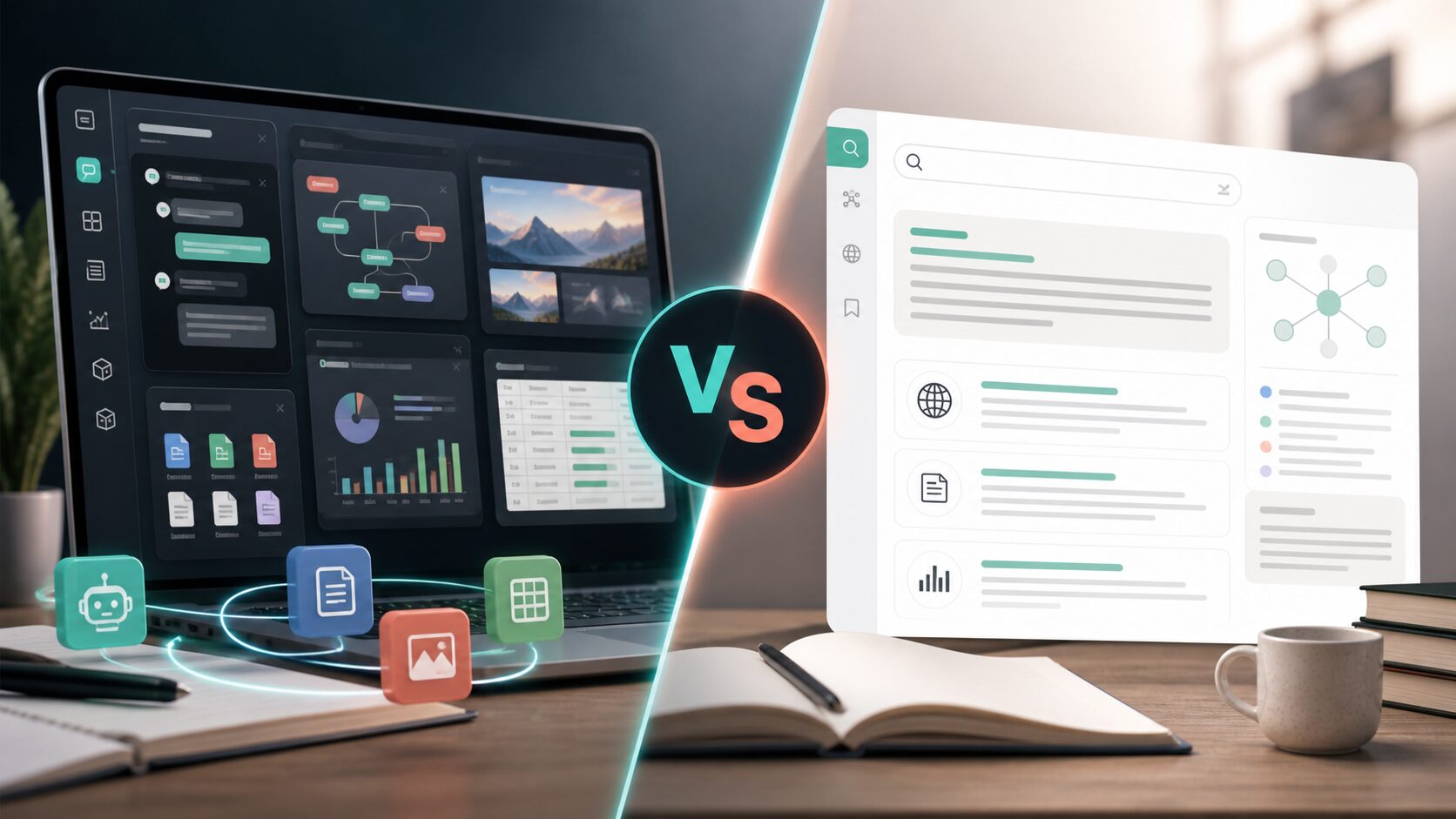
Choose Perplexity if your main need is fast AI search with citations. Choose Genspark if your need is broader: deep research, agent workflows, file work, slides, images, and multi-format deliverables. In short, Perplexity is an answer engine; Genspark is trying to be a research-to-output workspace.
Annual plan saves 20% — all AI models in one place
The Core Difference
Perplexity is strongest when the job is information retrieval: ask a question, get a concise answer, inspect citations, and move on. That makes it efficient for quick research checks, source discovery, and fact-finding. Genspark’s pitch is different. It wants the research step to continue into production: report, slide, table, file analysis, visual, or agent task.
This difference matters because users often compare tools at the wrong level. If the task is 'What happened?’ Perplexity may be faster. If the task is 'Research this, organize it, compare options, and turn it into something I can use,’ Genspark has a stronger argument.
Search and Deep Research Matrix
| Category | Genspark | Perplexity | Best choice |
|---|---|---|---|
| Quick cited answer | Capable, but broader than needed | Very strong | Perplexity |
| Long research report | Strong workspace fit | Useful but usually more answer-centric | Genspark |
| Source inspection | Depends on workflow and generated output | Core strength | Perplexity |
| Slides and deliverables | Native workspace direction | Usually requires external tools | Genspark |
| Multi-step agent tasks | Core product direction | Not the main identity | Genspark |
What Genspark Officially Says
Genspark’s Deep Research v2 announcement describes a research system built around model collaboration, multi-agent verification, process transparency, and denser final reports. The OpenAI case study also says Genspark moved beyond search into agentic AI, with Super Agent designed for tasks such as phone calls, slides, videos, and other no-code workflows.
Source: Genspark Deep Research v2 announcement.
Source: OpenAI customer story on Genspark Super Agent.
Where Perplexity Is Still Better
Perplexity remains hard to beat when you want fast, source-backed answers without building a broader deliverable. It is excellent for checking a claim, finding recent sources, getting a compact explanation, or collecting citations before writing elsewhere. The user experience is oriented around speed and source visibility.
If you already have a workflow for writing and presentation design, Perplexity can be the research layer that feeds those tools. In that case, Genspark’s all-in-one structure may feel unnecessary.
Where Genspark Is Better
Genspark is better when the research is not the endpoint. For example, a marketer comparing competitors may want a structured table, campaign angles, a slide outline, image prompts, and a final brief. A blogger may want a SERP-style comparison, FAQ ideas, and internal-link planning. A founder may want a market scan that becomes a deck. Genspark is designed for that broader chain.
The other advantage is consolidation. If you pay for separate tools for search, writing, slides, and images, Genspark may reduce the number of subscriptions. That is not guaranteed, but it is the right way to evaluate it.
Pricing Logic
Perplexity and Genspark should be compared by workflow cost, not only sticker price. If Perplexity gives you fast answers and you use free or existing tools for everything else, it may be cheaper. If Genspark replaces a research assistant, slide tool, and image workflow, the paid plan can make more sense even if the monthly price is higher.
Who This Is Best For
This comparison is best for users deciding between AI search and AI workspace subscriptions. Researchers, SEO writers, marketers, and analysts often need both speed and output quality. The decision should be based on where you lose the most time: finding sources, or turning research into finished material.
Plan Notes You Should Check Before Paying
- Whether your main work is quick source-backed answers or long research packages.
- Whether you need exports, slides, images, docs, or spreadsheets.
- Whether the plan’s credit system fits your expected research volume.
- Whether citations are visible enough for your publishing standards.
- Whether annual billing creates lock-in before you have tested the workflow.
20% off vs monthly — GPT, Claude, Gemini all included
Workflow Test: Fast Answer vs Finished Brief
Run this test before choosing. Ask both tools for a cited overview of a narrow topic, such as a competitor’s latest pricing change. Perplexity should feel fast and source-forward. Then ask both tools to turn the research into a structured brief with a table, implications, slide outline, and image ideas. This second step is where Genspark’s broader workspace approach may become more useful.
The right product depends on which step wastes more of your time. If your bottleneck is finding and checking sources, Perplexity may be the better daily tool. If your bottleneck is turning research into a deliverable, Genspark deserves a closer look.
Research Quality Checklist
| Question | Why it matters | Tool tendency |
|---|---|---|
| Can I inspect sources quickly? | Publishing and SEO work require verification. | Perplexity tends to emphasize this. |
| Can I turn results into assets? | Reports and slides are often the real deliverable. | Genspark tends to emphasize this. |
| Can I keep working in the same place? | Tool switching creates hidden time cost. | Genspark has the workspace advantage. |
| Can I get a concise answer in seconds? | Not every task needs a deep workflow. | Perplexity has the speed advantage. |
SEO and Content Research Notes
For SEO work, Perplexity is useful for fast SERP context, definitions, source discovery, and checking whether a claim is broadly supported. Genspark is useful when the same research needs to become a content brief, comparison table, FAQ map, or presentation. A content team may use Perplexity near the beginning of research and Genspark near the production stage.
The risk with either tool is over-trusting the summary. For publishable content, open the sources, check dates, and separate facts from strategic interpretation. This is especially important for pricing, subscription limits, refund policies, and model availability, because those details change often.
When Perplexity and Genspark Can Coexist
Using both can make sense for heavy research teams. Perplexity can be the quick source radar: what are people saying, what are the primary links, what changed recently? Genspark can then turn the verified source set into a richer deliverable. For casual users, paying for both may be unnecessary. Start with the tool that matches your most frequent task.
- Use Perplexity when speed and citations are the main requirement.
- Use Genspark when the output must become a report, table, slide, or multi-step asset.
- Use both only if your weekly workload clearly contains both patterns.
- Keep a manual verification step for any article or decision that affects money, health, law, or reputation.
A One-Week Research Testing Plan
Use Perplexity for fast source discovery and Genspark for research packaging during the same week. For every research task, record whether you needed a quick answer, a cited source list, a structured brief, a table, or a finished asset. Perplexity should win many quick-answer moments. Genspark should win when the result has to become something bigger than an answer.
At the end of the week, count how often you exported, copied, reformatted, or rebuilt the answer elsewhere. That is the hidden cost. If Perplexity gives fast answers but you always spend another hour building slides and tables, Genspark may be worth testing as the production layer. If Genspark feels slower and you rarely need deliverables, Perplexity may be the cleaner subscription.
For SEO work, keep a separate source-quality note. A fast answer is useful only if the sources are current and relevant. A polished deliverable is useful only if the underlying claims are verified. The best workflow may use both tools at different stages, but many individual users can choose one by identifying their true bottleneck.
A practical split is to use Perplexity at the start of research and Genspark at the end. Perplexity can quickly surface official pages, recent announcements, and competing articles. Genspark can then turn the verified material into a structured comparison, buyer guide, or slide outline. If you only do the first half, Perplexity wins. If you routinely do both halves, Genspark’s broader workspace becomes more attractive.
For publishing, build a verification pass into either workflow. Check dates, open primary sources, and remove unsupported numbers. AI search can make weak claims look confident, while AI workspaces can make weak claims look polished. The output format should never be confused with proof.
This is why the best tool is not always the one with the longest answer. For search-heavy work, clarity and citations can beat breadth. For deliverable-heavy work, structured output can beat raw speed.
That single distinction should drive the buying decision more than brand familiarity.
When in doubt, run one real research task from start to finish and measure the final edited deliverable, not the first draft.
That final-output test is the fairest way to compare an answer engine with a workspace.
FAQ
Is Genspark a Perplexity replacement?
Only for some workflows. Perplexity is excellent for fast cited answers; Genspark is broader when you need research to become slides, images, docs, or agent-driven outputs.
Which is better for quick search?
Perplexity is usually the cleaner choice for quick cited answers and fast fact-finding.
Which is better for deep research?
Genspark has the stronger argument when deep research is part of a longer workflow that includes tables, reports, slides, or multi-agent verification.
Which is better for SEO research?
Perplexity is useful for quick source-backed checks, while Genspark is better when the output needs to become a structured brief, comparison, or deliverable.
Should I pay for both?
Only if you use both patterns heavily: fast cited answer lookup and broader workspace production. Otherwise, test free tiers first.
Annual plan · 20% off · All AI models